Cross border reproductive care
What is cross-border reproductive care?
Cross-border reproductive care (CBRC) refers to traveling to another country to obtain reproductive services and treatment to avoid legal restrictions or high cost of treatment. Common fertility treatments provided within CBRC are intrauterine insemination, in-vitro fertilization, intracytoplasmic sperm injection, sperm donation, egg donation, embryo donation, pre-implantation genetic testing (PGT), social egg freezing, and depending on the country gestational surrogacy and sex selection. CBRC could be often used by advanced-aged patients, unmarried couples, single women, female same-sex couples who do not have access to certain fertility treatments in their countries.
What are the possible treatment scenarios involving CBRC?
Possible treatment scenarios for CBRC involve treatment with own eggs such as intrauterine insemination or IVF fertilization with or without preimplantation genetic testing or treatments with gamete donation such as sperm, egg or embryo donation. For patients who travel from their country of origin to receive fertility treatment in a clinic abroad their stay could be shortened as much as possible and is often limited to the last stages of monitoring and procedures like egg collection and embryo transfer.
CBRC scenario 1: IVF treatment with own eggs with fresh embryo transfer
CBRC patients undergoing IVF treatment with a planned fresh embryo could perform initial ultrasound and hormonal monitoring in their country and come abroad for the last stages of ovarian stimulation, egg collection and embryo transfer. Their total stay could amount to a maximum of 7-10 days.

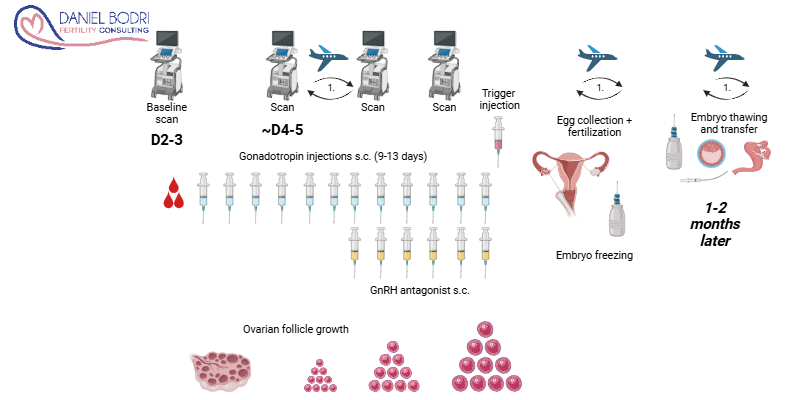
CBRC scenario 2: IVF treatment with own eggs with delayed frozen embryo transfer
CBRC patients undergoing IVF treatment with delayed frozen embryo transfer (e.g. in cases of PGT-A testing) could perform initial ultrasound and hormonal monitoring in their country and come abroad for the last stages of ovarian stimulation, egg collection. Because there is no fresh embryo transfer their total stay is shorter and could amount to a maximum 5-7 days. At later stage a second trip is scheduled for a subsequent frozen embryo transfer.
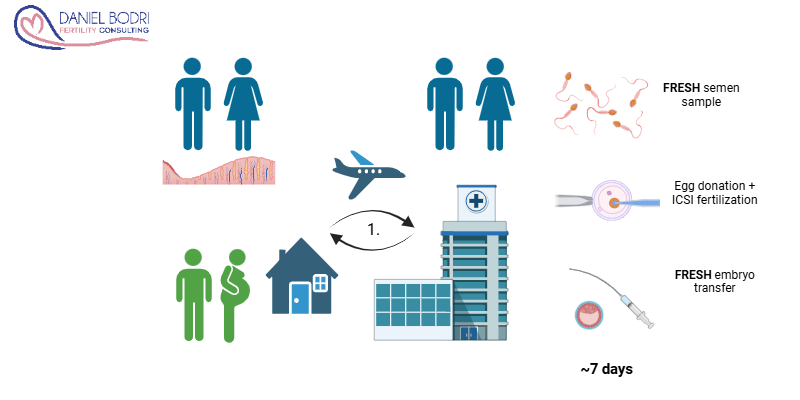
CBRC scenario 3: Egg recipient treatment using fresh partner sperm and fresh embryo transfer
CBRC patients undergoing egg recipient treatment using fresh sperm and fresh embryo transfer could perform initial ultrasound monitoring in their country and come abroad for fertilization of donor eggs (using fresh partner sperm) and embryo transfer. The total stay could amount to approximately 7 days.
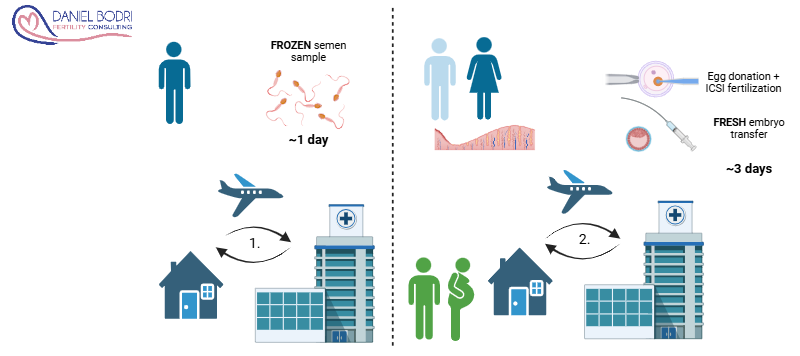
CBRC scenario 4: Egg recipient treatment using with frozen sperm and fresh embryo transfer
CBRC patients undergoing egg recipient treatment using previously frozen sperm (from partner or donor) and fresh embryo transfer could perform initial ultrasound monitoring in their country and come abroad only for the planned fresh embryo transfer. The total stay could amount to approximately 3 days. Before treatment start a previous short trip is needed to freeze partner sperm. If donor sperm is used this is already frozen.
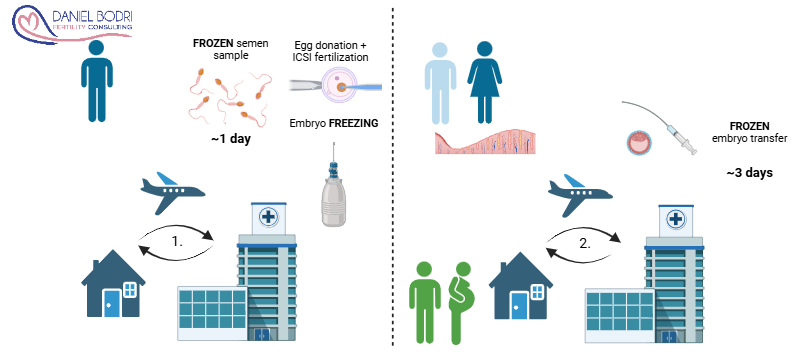
CBRC scenario 5: Egg recipient treatment with frozen sperm and delayed frozen embryo transfer
CBRC patients undergoing egg recipient treatment using previously frozen sperm (from partner or donor) and frozen embryo transfer could perform initial ultrasound monitoring in their country and come abroad only for the frozen embryo transfer. The total stay could amount to approximately 3 days. Before treatment start a previous short trip is needed to freeze partner sperm which could be used to fertilize fresh or frozen donor eggs. If donor sperm is used this is already frozen. The main difference compared with the previous scenario is that embryos are generated before the recipient’s endometrial preparation is started. This scenario is often the most convenient from a logistic point way and guarantees that embryo are already available before recipient’s treatment start.