
+34 624 835 088

info@danielbodri.com

Social egg freezing

What is social egg freezing?

Social egg freezing is the process of retrieving and storing eggs with the aim of using them later and thus preventing or at least mitigating the effects of age-related decline of female fertility.

Who are the best candidates for social egg freezing?

The ideal age to perform egg freezing is for women in their 20s or early 30s (35 years or younger). However, egg freezing is also often requested by older patients in their late 30s or early 40s, but their egg quality equality could be less good compared to younger patients.

What is the process of social egg freezing?

Egg freezing involves the process of a 10-12 day long ovarian stimulation with subcutaneous injections and serial ultrasound monitoring culminating in the egg collection which is a short 10-minute procedure performed under sedation. Retrieved eggs are checked by the embryologist in the lab and those that are mature will be placed on special devices, labelled and stored in liquid nitrogen.
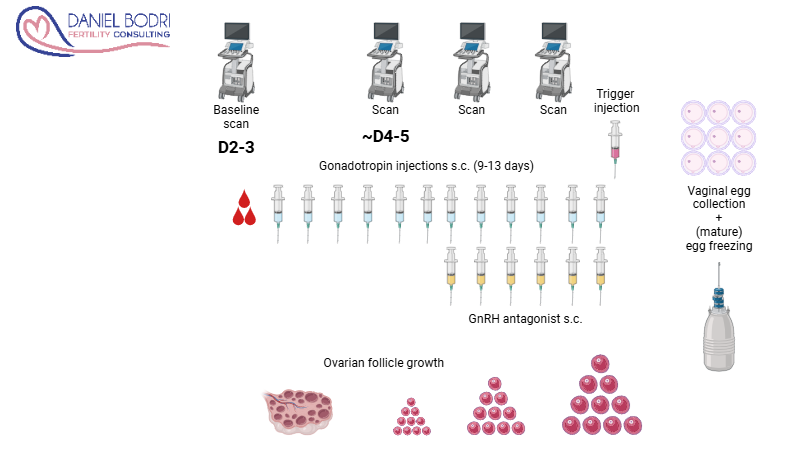
Social egg freezing

What tests are needed before starting social egg freezing?

Before starting an egg freezing process an initial consultation is done together with the evaluation of the patient’s ovarian reserve through ultrasound scanning and hormone tests (AMH). A simple bloodwork such as blood count, clotting screen, and infectious screening is also requested before starting treatment.

What are the side-effects and risks of social egg freezing?

The main side effects of egg freezing are temporary and reversible and could include bloating, lower abdominal discomfort, breast tenderness which is related to the growth of ovarian follicles. The risks involve ovarian hyperstimulation syndrome (OHSS), which nowadays could be practically prevented by using specific hormonal drugs and safe ovarian stimulation protocols. Egg collection could carry a small surgical risk (<0.5%) such as internal bleeding, the injury of anatomic structures, or pelvic infection.

Is egg freezing a safe procedure?

Egg freezing is considered a very safe procedure. The risk of ovarian hyperstimulation syndrome is nowadays practically zero and there is only a very small surgical risk (<0.5%) related to egg collection procedure itself. There are no reported long-term side effects and if needed egg freezing cycles could be repeated several times.

How many eggs do I need to freeze?

Usually, the recommended ideal pool of stored frozen eggs is around 16 to 20, which allows the subsequent generation of several embryos resulting potentially in more children born. Often 2 or 3 egg freezing cycles are needed to reach this number (with at least 1-2 months pause between treatments). However, having less eggs could also be sufficient to achieve a successful pregnancy.

How long frozen eggs could be stored?

The frozen eggs could technically be stored for decades without any deterioration. The practical upper limit off they are usage depends on the age limit until when at given clinic accepts to treat patients (often up until 50 years).

What is the success rate of social egg freezing?

The success rate of egg freezing largely depends on the female age. When eggs are stored before the age of 35, they have an over 90% potential off generating a live birth. In older patients this could be halved due to the decline in egg quality.
My cart
Your cart is empty.

Looks like you haven't made a choice yet.