
Egg donation
Who are the egg donors?
Egg donors are young and healthy women who decide to donate some of their eggs in a voluntary and anonymous manner. Although their motivation is often completely altruistic, they are also entitled to a fixed-sum compensation (around 1.000 Euros in Spain and 750 GBP in the UK). In Spain, egg donation is completely legal and is allowed since 1984.
What are requisites for egg donation?
The egg donor must be between 18-35 years old, physically and mentally healthy, with normal ovulatory function, without any evidence of genetic conditions, infectious diseases or congenital malformations. The prospective egg donor undergoes an initial consultation, gynaecological examination, transvaginal ultrasound with evaluation of her ovarian reserve, general bloodwork, infectious screening tests, a genetic testing (including karyotype and carrier genetic testing), and psychological evaluation.
What is the process of egg donation?
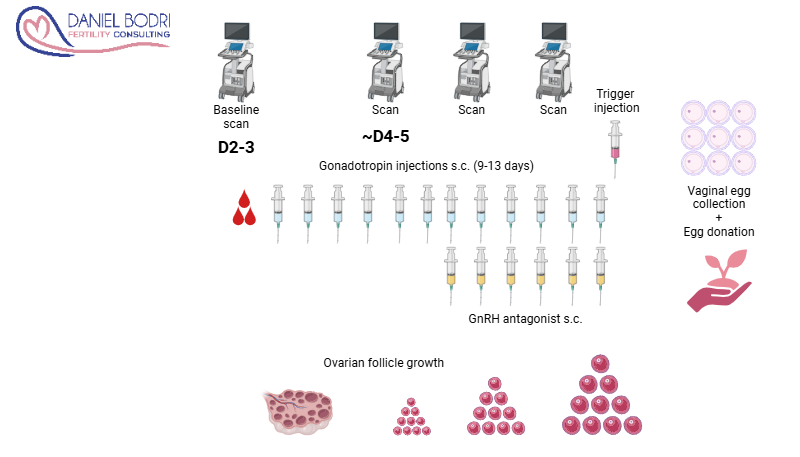
The egg donor’s treatment involves the process of a 10-12 day long ovarian stimulation with subcutaneous injections and serial ultrasound monitoring culminating in the egg collection which is a short 10-minute procedure performed under sedation. Retrieved eggs are checked by the embryologist in the lab and those that are mature will be fertilised with the recipient’s partner’s or donor sperm (whichever is applicable), or cryopreserved and stored in an egg bank.
What are the side-effects and risks of egg donation?
The main side effects of egg donation are temporary and reversible and could include bloating, lower abdominal discomfort, breast tenderness which is related to the growth of ovarian follicles. The risks involve ovarian hyperstimulation syndrome (OHSS), which nowadays could be practically prevented by using specific hormonal drugs and safe ovarian stimulation protocols. Egg collection could carry a small surgical risk (<0.5%) such as internal bleeding, the injury of anatomic structures, or pelvic infection.
How many times egg donors could donate?
In Spain, egg donors are registered in a National Register which keeps track of how many times an egg donor has donated in any of the country’s fertility clinics and also the number of donor-conceived children born form the same donor (in an anonymous way). In Spain, there is a limit maximum of 6 donation cycles with a minimum of 3 months between donation cycles.
How is anonymity managed during egg donation?
Donor anonymity is managed differently between different countries. In many countries any donor-conceived child has the possibility to find out identifying about her donor at the time of her majority (in the UK this is managed by the HFEA). In Spain, however egg donation is strictly anonymous, and the recipient could only find out basic non-identifying information about their donor which could become important during pregnancy follow-up (donor age and blood type).