
Preimplantation genetic testing
Which patients could benefit from preimplantation genetic testing?
The main patient group which could benefit from preimplantation genetic testing is advanced female age patients (38 years or above) whose age-related decline in egg negatively affects the proportion of chromosomically normal embryos. Other patient groups with recurrent pregnancy losses or previous failed embryo transfer could also benefit from the chromosomal testing of their IVF embryos.
What is the process of in-vitro fertilization with PGT-A?
For preimplantation genetic testing the patient has to undergo a successful IVF treatment involves the process of a 10-12 day long ovarian stimulation with subcutaneous injections and serial ultrasound monitoring culminating in the egg collection which is a short 10-minute procedure performed under sedation. Retrieved eggs are checked by the embryologist in the lab and those that are mature will available fertilised conventionally or using the ICSI procedure. Resulting embryos cultured with prolonged embryo culture until the blastocyst stage. The blastocysts are biopsied (a sample of 5-10 cells is removed from the outer part) and the sample is processed in the molecular genetics lab. A result 2-3 weeks later will confirm which of the analysed embryos are chromosomically normal and could be used for a subsequent frozen-thawed embryo transfer.
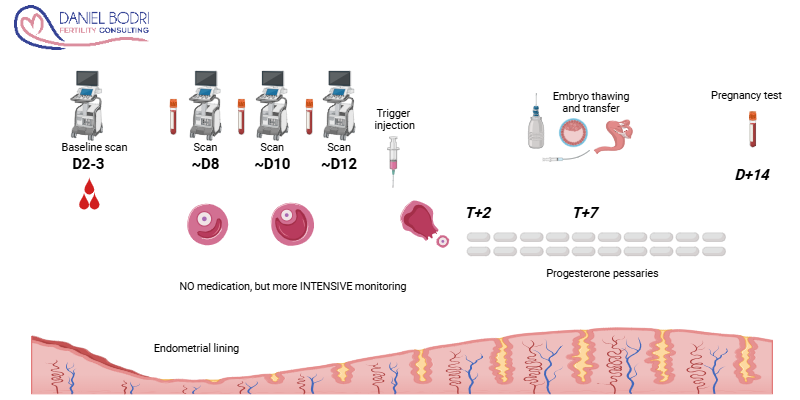
What are the benefits and drawbacks of the artificial hormonal cycle endometrial preparation protocol?
The main benefit of the artificial hormone replacement protocol is the possibility of the exact scheduling of the frozen-thawed embryo transfer due logistical considerations. When it is used with a pre-treatment hormonal downregulation, this could be beneficial for patients with severe endometriosis and/or adenomyosis. The drawback of the artificial hormone replacement protocol is that a higher amount of hormonal medication is used often including injectables too. The artificial hormone replacement protocol is the only preparation method for women who have irregular cycles or who are menopausal.
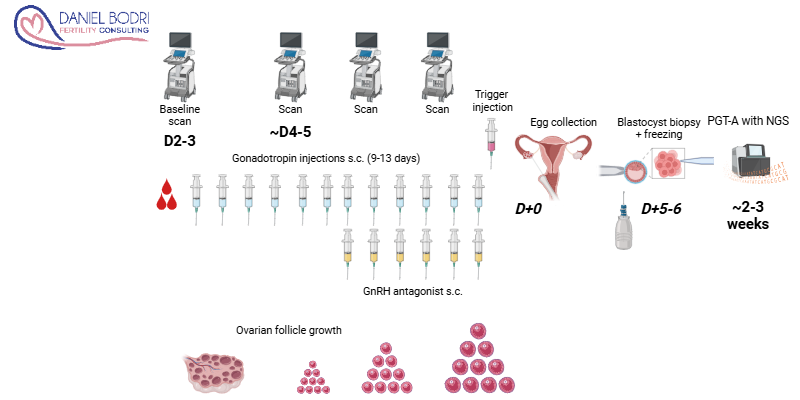
How is PGT-A testing performed?
The genetic material from the sample of retrieved cells is amplified using next generation sequencing (NGS) and the chromosomal status of the samples from each biopsied embryo is confirmed. Euploid chromosomically normal embryos could be used for a subsequent frozen-thawed embryo transfer. Mosaic embryos containing a mixture of chromosomically normal and abnormal cells could also be potentially transferred, but only after case-by-case evaluation and appropriate genetic counselling and.
Are there any risks related to PGT-A testing?
The embryo biopsy (sampling) from the outer part of an advanced-staged day 5-6 blastocyst is considered to be safe and it is not thought to negatively affect the implantation potential of tested embryos. However, a favourable PGT-A test result is not a guarantee for the establishment of an initial pregnancy or the avoidance of an early pregnancy loss or other pregnancy complications.
What is the success rate of in-vitro fertilization with PGT-A?
Success rates calculated per embryo transfer, when a chromosomically normal euploid blastocyst is used, could be as 70-75%, but they also depend on factors affecting embryo implantation such as uterine or immunological factors. The risk of an early miscarriage is usually also diminished compared to the age-related baseline risk which is high. The main issue with IVF coupled with PGT-A testing is that by far not all advanced maternal age patients who start IVF treatment could reach the stage of a successful blastocyst biopsy or could receive a favourable PGT-A result. However, even in those cases where the PGT-A result is unfavourable an unnecessary (aneuploid) embryo transfer could be avoided and the information obtained could help the patient in switching to other treatment options (such as using donor eggs).