
Ovulation induction
Which patients need OI treatment?
Infertile patients who have been trying to get pregnant unsuccessfully for at least 1 year could opt for simpler treatments such as ovulation induction (OI) treatment. OI treatment is mainly indicated in younger, good-prognosis patients (35 years or younger) in the presence ovulatory dysfunction which includes anovulation due to polycystic ovarian syndrome and other causes.
What tests are required before starting OI treatment?
Before starting OI treatment an initial consultation is done together with the evaluation of the patient’s uterus and ovaries through ultrasound scanning and hormone tests and a detailed sperm analysis. Usually, it is also recommended the verify of tubal patency which could be achieved by ultrasound Hycosy test or classical X-ray hysterosalpingography. A simple bloodwork such as blood count and infectious screening is also often requested for both partners (if applicable) before starting treatment.
What is the process of OI treatment?
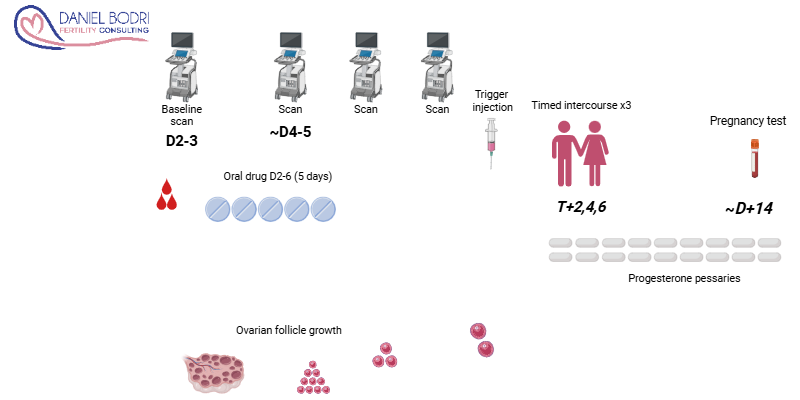
OI treatment is usually performed with the use of oral ovulation induction agents such as letrozole or clomiphene which are given during a few days only in the first half of the menstrual cycle. The development of dominant follicle(s) is monitored with serial ultrasounds and hormonal testing. When this confirmed, the ovulation is induced and repeated timed intercourse is scheduled around the time of ovulation. Usually, several cycles (up to 3-6) are performed to increase the cumulative success rates.
What are the side-effects and risks of OI treatment?
The side effects of OI treatment are usually mild and could be minimized by careful monitoring. The risks OI treatment are the occurrence of multiple pregnancies and ovarian hyperstimulation syndrome (OHSS). Special attention is paid to thorough ultrasound and hormonal monitoring and avoiding the OI procedure if more than 2 leading follicles develop.
What is the success rate of OI treatment?
The success rate of OI treatment largely depends on the female age, the quality of sperm and whether ovulation was successfully induced by the chose treatment. Usually, in younger patients (<35 years) pregnancy rates per OI cycle could reach 15-20%, but in older patient this could be much lower. In good-prognosis patients up to 3-6 cycles could be performed to increase cumulative success rates.