
Ovarian PRP treatment
What is the process of ovarian PRP treatment?
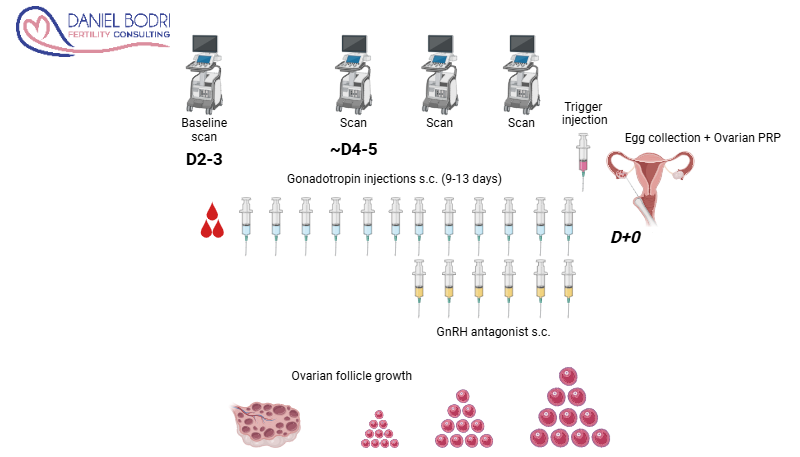
Ovarian PRP treatment involves the preparation of platelet-rich plasma (called PRP or PRGF) from the patient’s own blood and infiltrating it under sedation into both ovaries. This could be performed following ovarian stimulation concomitantly with the egg collection procedure or outside of ovarian stimulation. The procedure is followed by hormonal and ultrasound monitoring and if ovarian reserve markers increase a subsequent ovarian stimulation is planned.
Who are the potential candidates for ovarian PRP treatment?
Candidates for ovarian PRP treatment include patients with diminished ovarian reserve, poor prognosis IVF patients with failed IVF cycles due to low embryo yield/quality as well as patients with premature ovarian failure (patients < 40 years, idiopathic origin), or perimenopause / natural menopause patients in their late 40s or 50s.
What is PRP and how it is obtained?
Platelet rich plasma or PRP is composed of activated platelets is small volume of plasma containing of platelet-derived growth factors and cytokines. It is obtained from the patient’s own blood with centrifugation and activation of platelets. PRP was first used in open heart surgery in 1987 and is now widely used in many areas of medicine (orthopedics, traumatology cosmetic surgery, wound care, ophthalmology, neurosurgery).
What are the benefits and drawbacks of ovarian PRP treatment?
Ovarian PRP could be performed as part of an already planned embryo banking treatment taking advantage of the egg collection procedure to perform PRP infiltration of both ovaries. If ovarian reserve markers increase a subsequent ovarian stimulation performed during the next 6 months could yield more eggs and potentially resulting in more embryos. The drawback is the additional cost of the blood processing for a treatment that is still considered to be experimental.
What are the side-effects and risks of ovarian PRP treatment?
The preparation of PRP is safe because it is prepared from the patient’s own blood under a strict protocol using a closed system and aseptic conditions. The infiltration of both ovaries is often performed at the same time as the egg collection procedure under sedation. Ovarian puncture could carry a small surgical risk (<0.5%) such as internal bleeding, the injury of anatomic structures, or pelvic infection.
What is the success rate of ovarian PRP treatment?
Ovarian PRP treatment is still considered experimental, and to date the published scientific evidence on its efficiency is still scarce. Patients submitted ovarian PRP treatment often undergo repeated stimulation cycles so-called embryo banking/accumulation, therefore their results need to be evaluated on a cumulative basis. When ovarian PRP treatment is used in patient with a very low ovarian reserve or perimenopausal/menopausal patients success rates could be deceptively low.