
Intrauterine insemination
Which patients need IUI treatment?
Infertile patients who have been trying to get pregnant unsuccessfully for at least 1 year could opt for simpler treatments such as intrauterine insemination (IUI) treatment. Usually, it is indicated in younger patients (35 years or younger) whose tubes are not blocked and if sperm quality is normal or only mildly altered. IUI treatment could be indicated in the presence ovulatory dysfunction, cervical factor, mild endometriosis, vaginismus mild male factor, and unexplained infertility. Also, single women or members of female same-sex couples could undergo IUI treatment with donor sperm.
What tests are required before starting IUI treatment?
Before starting IUI treatment an initial consultation is done together with the evaluation of the female patient’s ovarian reserve through ultrasound scanning and hormone tests (AMH) and a detailed sperm analysis. An essential requisite for IUI treatment is the verification of tubal patency which could be achieved by ultrasound Hycosy test or classical X-ray hysterosalpingography. A simple bloodwork such as blood count, clotting screen, and infectious screening is also requested for both partners (if applicable) before starting treatment.
What is the process of IUI treatment?
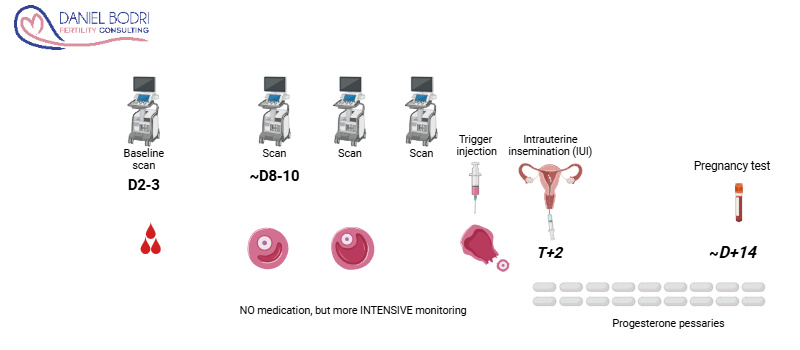
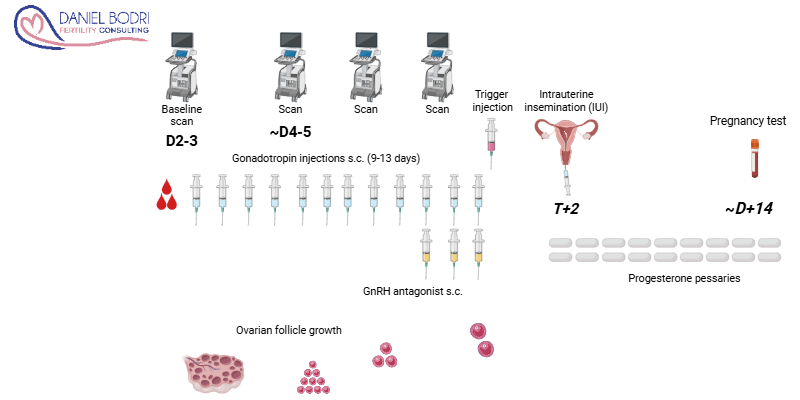
IUI treatment could be performed in a natural cycle or in a mildly stimulated cycle with tablets or subcutaneous injections. In both cases the development of dominant follicle(s) is monitored with serial ultrasounds and hormonal testing. When this confirmed, the ovulation is induced and the IUI procedure is scheduled shortly thereafter. The IUI procedure itself is painless and involves the preparation of a partner or donor sperm sample in the lab and introducing it inside the uterine cavity with the help of a thin catheter. Usually, several cycles (up to 3-6) are performed to increase the cumulative success rates.
What are the side-effects and risks of IUI treatment?
The side effects of IUI treatment are usually mild and could be minimized by careful monitoring. The risks IUI treatment are the occurrence of multiple pregnancies and ovarian hyperstimulation syndrome (OHSS). Special attention is paid to thorough ultrasound and hormonal monitoring and avoiding the IUI procedure if more than 2 leading follicles develop.