
Frozen embryo transfer
What is the success rate of mild or natural cycle IVF?
The success rate of mild or natural cycle IVF largely depends on the female age, but also on the quality of sperm and factors related to the womb and embryo implantation. However, compared to conventional IVF because of a lower number of eggs retrieved (or only one egg with natural cycle IVF) the risk of not having an embryo to transfer is higher. Usually, in younger patients (<35 years) pregnancy rates per embryo transfer could be satisfactory (40-45%). Compared to conventional IVF the cumulative pregnancy rate from one stimulation attempt could be lower, but mild or natural cycle IVF could be repeated more easily.
What is the process of frozen embryo transfer?
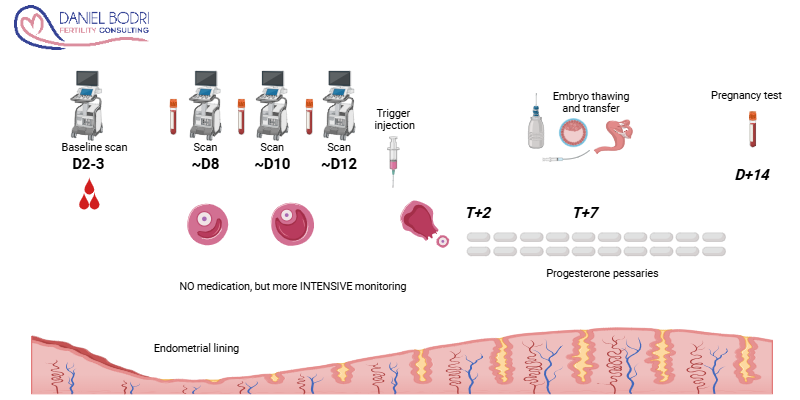
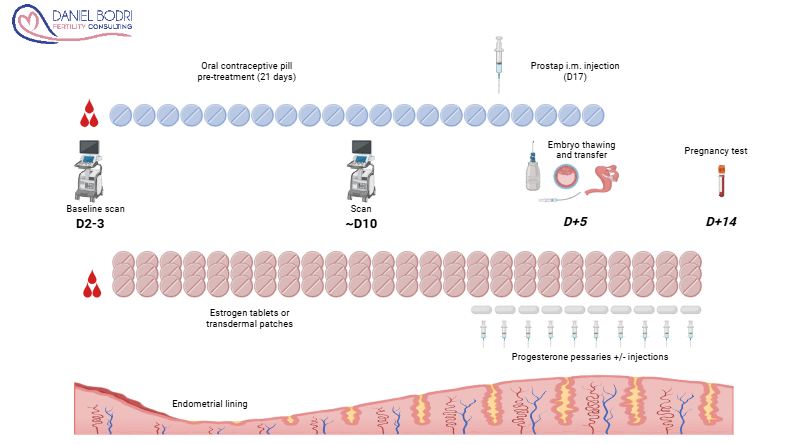
Frozen-thawed embryo transfer involves endometrial preparation using different protocols, such as modified natural or artificial cycle protocol. This starts from the onset of the menstrual period and last approximately 3 weeks until the scheduled day of frozen-thawed embryo transfer procedure. The frozen embryo is thawed on the day of the embryo transfer itself a few hours before the procedure. A pregnancy test 10-14 days after embryo transfer will confirm whether the embryo implanted or not.
What are the endometrial preparation protocols for frozen embryo transfer?
The two main approaches to endometrial preparation are the modified natural cycle and artificial hormone replacement protocols. With the modified natural cycle protocol, the development of the patient’s own dominant follicle allows the production of endogenous progesterone and the use of less hormonal medication. With the artificial hormone replacement protocol, external hormonal drugs are used exclusively to achieve good endometrial development and the exact scheduling of the frozen-thawed embryo transfer procedure.
What are the benefits and drawbacks of the natural cycle endometrial preparation protocol?
The benefits of the modified natural cycles protocol are the reliance on the patient’s own hormonal production and the use of less external hormonal medication. This more natural approach is also associated with a lower risk of pregnancy complications occurring during later stages of the pregnancy due to better early placental development. The drawbacks of the modified natural cycles protocol are that it could be only used for cycling women with regular cycles and required a closer ultrasound and hormonal monitoring.
What are the benefits and drawbacks of the artificial hormonal cycle endometrial preparation protocol?
The main benefit of the artificial hormone replacement protocol is the possibility of the exact scheduling of the frozen-thawed embryo transfer due logistical considerations. When it is used with a pre-treatment hormonal downregulation, this could be beneficial for patients with severe endometriosis and/or adenomyosis. The drawback of the artificial hormone replacement protocol is that a higher amount of hormonal medication is used often including injectables too. The artificial hormone replacement protocol is the only preparation method for women who have irregular cycles or who are menopausal.
Which are the prognostic factors that affect the success of frozen thawed embryo transfer?
The success rate of frozen-thawed embryo transfer largely depends on the quality of the embryos used which depend on prognostic factors such as female age and other factors. The thickness and the quality of the endometrial lining and other uterine factors are also important and could be evaluated by non-invasive ultrasound scanning or other methods such as endometrial biopsies.