
Shared motherhood IVF
What is shared motherhood IVF treatment?
Shared motherhood IVF treatment involves a female same-sex couple who decides to undergo a common parental project by one of the female partners providing her eggs and the other female partner having an embryo implanted in her womb and carrying the resulting pregnancy. Thus, motherhood would be shared, as one partner provides a genetic link, whereas the other would carry a baby during the whole duration of the pregnancy and give birth. Afterwards both mothers would act as social mothers of their children born.
Why female same-sex couples choose to do shared motherhood IVF?
The main motivation to choose this option is related to the fact the female same-sex couples have a unique possibility of carrying a baby created from the egg of their partner (also using donor sperm). Compared to simpler treatment options (like intrauterine insemination with donor sperm) where the genetic and gestational mother is the same person (and the other female partner can “only” have the social motherhood role) this treatment option allows a true sharing of motherhood from the very early stages conception and subsequent pregnancy. For those couples where there is a medical reason (issues with egg quality or the womb) this treatment allows same-sex couples to “help out each other” and avoid egg donation or surrogacy treatment involving a third-party.
What is the process of shared motherhood treatment?
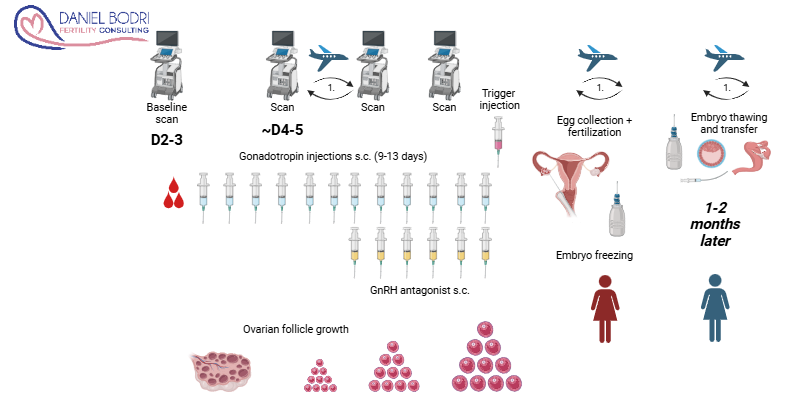
For the partner who provides her eggs the process involves a 10-12 day long ovarian stimulation with subcutaneous injections and serial ultrasound monitoring culminating in the egg collection which is a short 10-minute procedure performed under sedation. Afterwards the retrieved eggs are fertilized with donor sperm in the embryology laboratory and cultured until the stage of day 5-5 embryo called the blastocyst. For the partner who will carry the pregnancy, she should undergo a 3-week long endometrial preparation with oestrogen/progesterone hormones or in a monitored natural cycle culminating in the implantation of a single fresh or frozen embryo (depending on whether a synchronized or non-synchronized approach is chosen).
What treatment scenarios are possible with shared motherhood IVF?
The two main treatment scenarios are the synchronized and non-synchronized approach. With synchronized approach the egg provider and the recipient follow their respective treatments (ovarian stimulation and endometrial preparation) contemporaneously. Its advantage is that there is no delay in implanting an embryo, but logistically this could be more challenging as both partners are undergoing treatment at the same time. With the non-synchronized approach, first ovarian stimulation, egg collection and the fertilization process are completed and resulting embryos are frozen. Subsequently once the egg providing partner has completed completely recovered the recipient partner will start her part of the treatment process and undergo endometrial preparation and frozen embryo replacement. Its advantage that both partners can support each other more easily as only of them is under treatment at a time.
What are the expected success rates of shared motherhood IVF?
Success rates are individual to each same-sex couple and depend on factors determining oocyte quality (mainly age of the egg provider) and uterine factors of recipient partner (the status of the womb and uterine lining). Generally, for couples below 35 years of age pregnancy rates are excellent and could be as high as 65% per each embryo transfer performed.
Is shared motherhood IVF a safe treatment?
Just like IVF treatment in general shared motherhood IVF treatment is considered safe. For the partner who undergoes ovarian stimulation the risk of ovarian hyperstimulation syndrome (OHSS) could be largely prevented by using modern stimulation protocols and the surgical risk of egg collection is very small (<0.5%). For the partner who undergoes embryo transfer a single embryo transfer is routinely recommended (to reduce the risk of multiple pregnancy) and the risk of pregnancy complications are not substantially higher than for any other patient undergoing IVF treatment.
Is shared motherhood IVF treatment allowed in every European country?
Shared motherhood IVF treatment is not allowed or not routinely practiced in every European country (or in other countries worldwide). Generally, it tends to be allowed in countries with less restrictive ART legislation and where LBTQ patients are not discriminated. In Europe, it has been first described in Spain (2010) and is routinely practiced in the UK and Belgium. However, it might not be a routine treatment in other countries, even in those where there is no explicit ban to perform this treatment.
Can shared motherhood IVF treatment be performed in the context of cross-border reproductive care (CBRC)?
For couples who wish to undergo shared motherhood IVF treatment from abroad the initial steps are to schedule an initial online consultation and perform the necessary testing (bloodwork and ultrasound) at home. Afterwards at a convenient time for them they could schedule their treatment start abroad (in a country like Spain) and come to the clinic for the ovarian stimulation, egg collection and embryo implantation. The resulting pregnancy is followed up in their country of residence.
Are there are any legal or ethical considerations related to shared motherhood IVF?
In Spain and some other countries, to undergo shared motherhood IVF treatment same-sex couples must be married or live in a registered partnership (a documented proof of this must be provided before starting treatment). Depending on their country’s legislation both female partners could be recognized as legal parents, but in some countries only the birth mother is recognized as such, and the genetic mother needs to do additional legal proceedings (this could become very important in case of any future separation or divorce).
Are there any follow-up studies on shared motherhood IVF treatment?
Although it was first described in Spain in 2010, there is still a relative scarcity of studies on the outcomes of shared motherhood IVF studies. A recent meta-analysis analysing reports from Spain, UK and the US showed encouraging results after more than a decade of experience with shared motherhood IVF treatment.