
Fertility preservation of oocytes or social egg freezing has been on the rise in recent decades. Since the development of modern freezing methods such as vitrification the cryopreservation of oocytes has entered routine clinical practice. With oocyte survival rates of 90% or above the method has become a viable option for fertility preservation for patients undergoing cancer treatment or for women who simply wanted to avoid the age-related fertility decline. Social egg freezers have different profiles, different backgrounds and motivations. “Young” egg freezers could be considered proactive planners, in their 20s or early 30s, who are well-informed and have very clear ideas about fertility preservation. “Late” freezers are already under pressure due to “their biological clock ticking”, might be still single, in their late 30s or early 40s and who are planning to buy some extra years before seriously considering having children or even undergoing more complex fertility treatment. Another group of people could be egg freezers who are in a relationship, but their partner is not ready to have children or is too old. These patients might simply plan to freeze eggs for a potential future second relationship. Especially for younger women who are still building their career bearing the cost of sometimes several egg freezing cycles is a considerable financial burden and they might consider going abroad to reduce the cost of the treatment.
Why women consider doing egg freezing abroad?
In some countries egg freezing is not allowed or still judged experimental or generally not routinely offered. Additionally in some countries singles are not allowed to freeze their eggs although they are the ones who are really in need of fertility preservation in the first place. In some countries fertility treatment available is mainly available in the public sector and these centers might not consider egg freezing as a priority and might rather offer fertility treatments for couples who are infertile. In Europe, egg freezing has been well established for decades in Spain, UK, and Belgium (among others). In France fertility preservation has become available only recently after a legislative change that granted access to fertility care for single women. However, the public system is still coping with the increased demand. In countries like the UK or US, egg freezing (especially if several rounds are needed) is prohibitively expensive and women are constrained to look for options abroad.
Is it logistically manageable and safe?
An egg freezing treatment is uniquely suitable for a cross-border reproductive care (CBRC) scenario. Women choosing to undergo egg freezing treatment abroad could do their initial assessment through an online consultation as well as the required test in their home country after which the treatment stage (ovarian stimulation and egg collection) could last approximately up to 2 weeks. They could perform initial ultrasound and hormonal monitoring in their home country too and come abroad for the last stages of ovarian stimulation and egg collection. In this case their total stay abroad is relatively short and could amount to a maximum of 5-7 days only. Egg collection itself is a short, painless procedure performed under sedation. After egg collection if no complication occurs, it is safe to take a flight back home 24-48 hours after the procedure. The risks of ovarian hyperstimulation nowadays could be largely avoided by choosing the appropriate stimulation protocols.
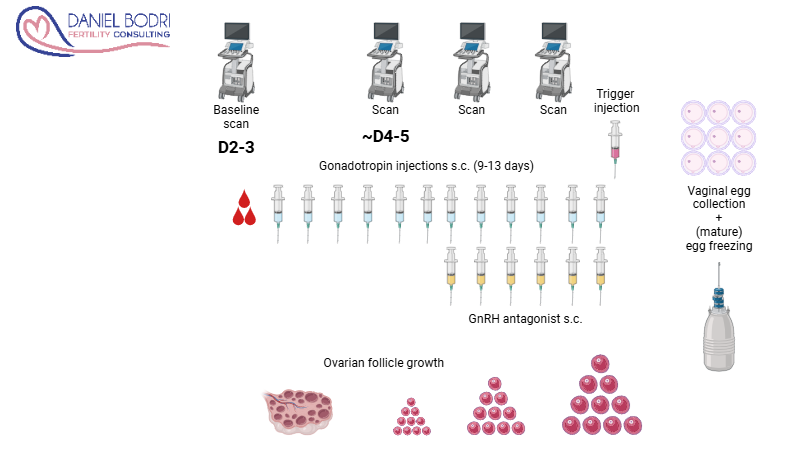
How to choose a suitable clinic for egg freezing?
Below are some considerations when choosing a potential clinic for egg freezing treatment abroad. A well-established, usually private center with a significant number of yearly treatment cycles is a guarantee that it is well versed in managing a significant number of treatments. An experienced embryology lab (especially in the egg freezing method or vitrification itself), one that has a donor egg bank too (donor eggs are also frozen and thawed with the same vitrification method) with the appropriate ISO certificates, and total quality control management in place is another guarantee for satisfactory laboratory results. This is important not only when the eggs are frozen, but also later when they are thawed and fertilized to achieve an embryo and a potential pregnancy. A clinic that publishes its own statistics (on its own website or through available national registries), does research activity is an indication that it values transparency, has high clinical standards and uses the latest technologies. An additional requirement is to have experience with managing CBRC patients, which requires efficient patient care involving multilingual medical staff as well as dedicated personal care assistants who are in constant communication with the patient during the whole process. Finally, a well-staffed clinic with non-stop operation of at least 6 or even 7 days a week is required to allow the smooth scheduling of treatments and egg collections which could be performed during weekends and holiday periods too.