Why female same-sex couples choose to do shared motherhood IVF?
The main motivation to choose this option is related to the fact the female same-sex couples have a unique possibility of carrying a baby created from the egg of their partner (also using donor sperm). Compared to simpler treatment options (like intrauterine insemination with donor sperm) where the genetic and gestational mother is the same person (and the other female partner “only” fills out the social motherhood role) this treatment option allows a true sharing of motherhood from the very early stages conception and subsequent pregnancy. For those couples where there is a medical reason (issues with egg quality or the womb) this treatment allows same-sex couples to “help out each other” and avoid egg donation or surrogacy treatment involving a third-party.
Is shared motherhood IVF treatment allowed in every European country?
Shared motherhood IVF treatment is not allowed or not routinely practiced in every European country (or even in other countries worldwide). Generally, it tends to be allowed in countries with less restrictive ART legislation and where LBTQ patients are not discriminated. In Europe, it has been first described in Spain (2010) and is routinely practiced in the UK and Belgium (could be also performed in Ireland, and Portugal). However, it might not be a routine treatment in other countries, even in those where there is no explicit ban to perform this treatment (e.g. Germany, Italy, and France). In contrast, in some Central- or Eastern European countries female same-sex couples are not even granted access to any type of assisted reproduction services. Therefore same-sex couples considering shared motherhood treatment could find easier to seek treatment abroad.
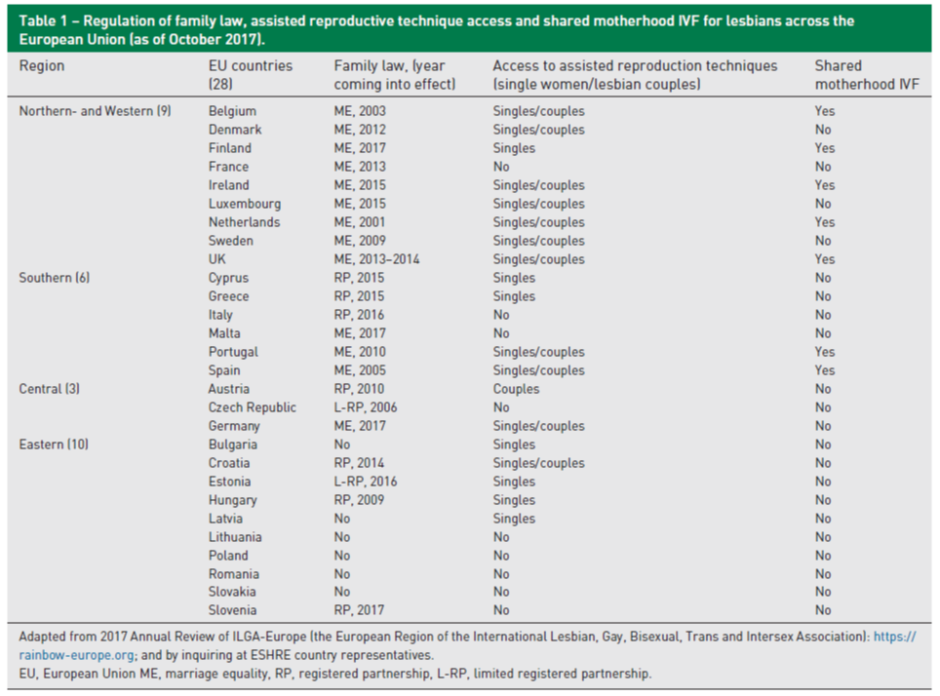
Table from Bodri D et al (RBMO, 2017).
Can shared motherhood IVF treatment be performed in the context of cross-border reproductive care (CBRC)? Is it logistically manageable and safe?
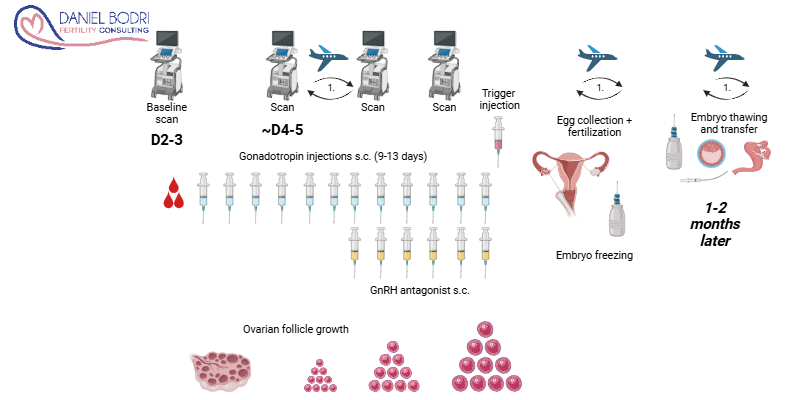
For same-sex couples who wish to undergo shared motherhood IVF treatment abroad, they could do their initial assessment through an online consultation and the required test in their home country after which the treatment stage (ovarian stimulation and egg collection) could last approximately up to 2 weeks. During the treatment they could perform initial ultrasound and hormonal monitoring in their home country and come abroad for the last stages of ovarian stimulation and egg collection. In this case their total stay abroad is relatively short and could amount to a maximum of 5-7 days only. Egg collection itself is a short, painless procedure performed under sedation. After egg collection if no complication occurs, it is safe to take a flight back home 24-48 hours after the procedure. The risks of ovarian hyperstimulation nowadays could be largely avoided by choosing the appropriate stimulation protocols. Embryo implantation could be performed shortly after egg collection or at later date if embryos are frozen. The resulting pregnancy is followed up in their country of residence.
How to choose a suitable clinic for shared motherhood IVF treatment?
Below are some considerations when choosing a potential clinic for shared motherhood IVF treatment abroad. It goes without saying that clinics offering shared motherhood treatment are all “LGBTQ-friendly” and they treat same-sex couples the same way as any other patient, without the hint of any discrimination. They might already have a significant experience treating female same-sex couples for intrauterine insemination with donor sperm which is a more common treatment option. Some clinics also might have their own donor sperm bank, although most use the services of an external sperm bank. A well-established, usually private center with a significant number of yearly treatment cycles is a guarantee that it is well versed in managing a significant number of treatments. An experienced embryology lab with the appropriate ISO certificates, and total quality control management in place is another guarantee for satisfactory laboratory results. A clinic that publishes its own statistics (on its own website, through available national registries or scientific papers), does research activity is an indication that it values transparency, has high clinical standards and uses the latest technologies. An additional requirement is to have experience with managing CBRC patients, which requires efficient patient care involving multilingual medical staff as well as dedicated personal care assistants who are in constant communication with the patient during the whole process. Finally, a well-staffed clinic with non-stop operation of at least 6 or even 7 days a week is required to allow the smooth scheduling of stimulation treatments, egg collections and embryo transfers which could be performed during weekends and holiday periods too.